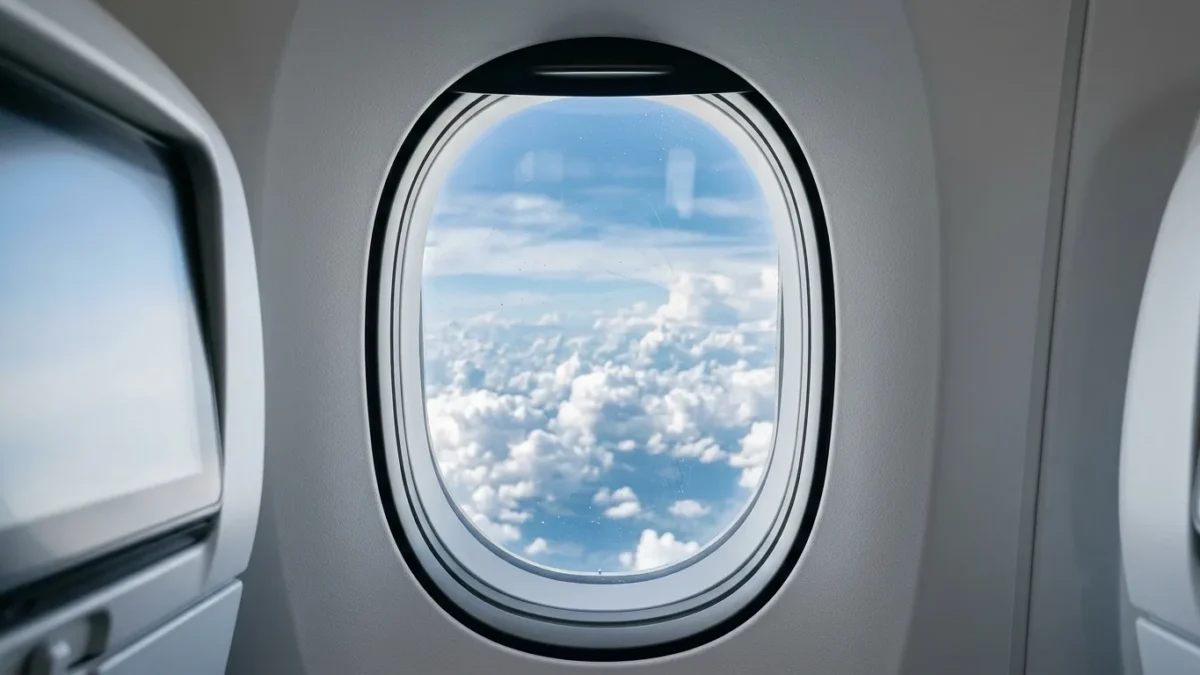
Why Plane Windows Are Round, Not Square
The gentle curves of an airplane window are not a styling choice but a hard lesson written into aviation history by physics and a series of early tragedies.
Next time you settle into a window seat, run your finger along the edge of the glass. You will feel a soft, rounded curve where you might expect a crisp corner. That curve is doing quiet, constant work. It is one of the most elegant safety features on the entire aircraft, and almost no passenger ever notices it.
Square windows seem like the obvious choice. They are cheaper to cut, easier to frame, and they match the rectangular world of houses and trains. For a brief and hopeful moment in the early 1950s, airplanes had them too. Then the lesson arrived, and it arrived hard.
The shape of a stressed cabin
A passenger cabin at cruising altitude is essentially a balloon. Outside, the air is thin and cold. Inside, the cabin is pumped up to a comfortable pressure so we can breathe and stay warm. The difference between those two pressures pushes outward on every square inch of the fuselage, thousands of times on every flight, as the plane climbs and descends.
Metal can handle a great deal of that pushing and pulling. What it handles poorly is a sharp corner. When stress flows through a structure, it behaves a little like water in a river: it speeds up and crowds together wherever the channel narrows or turns abruptly. Engineers call this stress concentration. At a sharp 90-degree window corner, the force does not spread evenly. It piles up in a tiny region, sometimes several times higher than the average load on the surrounding skin.
A rounded corner gives that stress somewhere to go. The curve lets the force fan out smoothly around the opening instead of jamming into a single point. The wider the curve, the gentler the flow, and the longer the metal survives the endless cycle of pressurizing and depressurizing.
Klik hieronder op de knop Verder lezen om door te lezen.
Reacties (4)