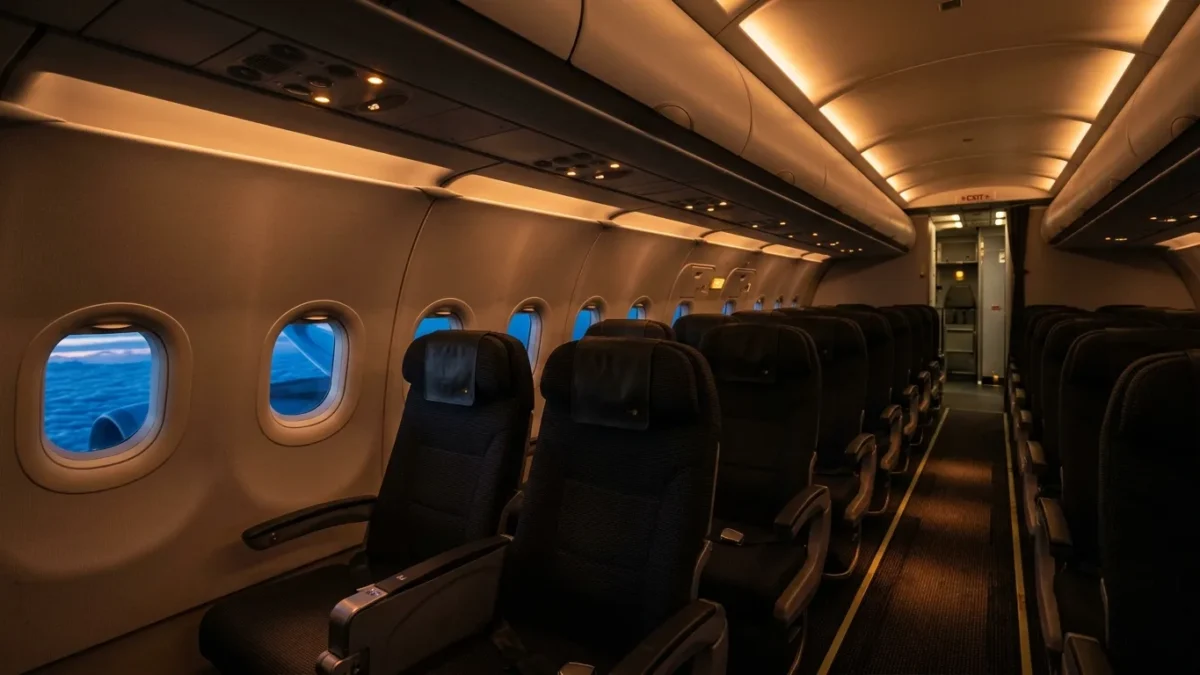
The Real Reason Airlines Dim the Lights for Takeoff
When the cabin goes dark before takeoff and the crew asks you to lift the window shades, it isn't about mood lighting — it's a quiet piece of safety engineering built around the human eye.
The cabin lights drop a notch, the engines settle into a low hum, and a flight attendant walks the aisle asking everyone to slide their window shades up. Most passengers barely register the moment. It feels like routine theater, the airline equivalent of a deep breath before the run down the runway. But the dimming is not decoration, and it is not about helping you nap. It is a deliberate safety measure, timed to the exact minutes of flight when something is statistically most likely to go wrong.
Takeoff and landing are when aviation accidents cluster. Industry safety reviews have long described the period from the start of the takeoff roll to a few minutes after, and the final descent through touchdown, as the “critical phases” of flight. The aircraft is low, slow, heavy with fuel, and close to the ground. Crews prepare for these windows not because they expect trouble, but because the cost of being unprepared is measured in seconds.
Your eyes are slow to adjust
The core reason for dimming the lights has nothing to do with the plane and everything to do with you. The human eye does not switch instantly between bright and dark. When you walk from a sunlit street into a dark cinema, there is a stretch of helpless blindness before shapes resolve. That process is called dark adaptation, and the slow part of it can take many minutes to complete.
Now imagine an emergency at night. If the cabin had been brightly lit and the lights suddenly failed, every passenger would be momentarily blind at the worst possible moment, groping for an aisle they can no longer see. By dimming the cabin before takeoff and landing, the crew lets everyone’s eyes pre-adjust to lower light. If the worst happens and the interior goes dark, your vision is already partway there. You can find the floor-level escape path lighting, the aisle, the exit signs.
The lights are dimmed so that if the cabin loses power, your eyes are already tuned to the dark — and the difference can be the seconds it takes to find an exit.
It is a small intervention with an outsized payoff. The airline is not predicting a failure. It is removing one specific disadvantage — the lag in human night vision — from the list of things that could slow an evacuation.
Klik hieronder op de knop Verder lezen om door te lezen.
Reacties (4)