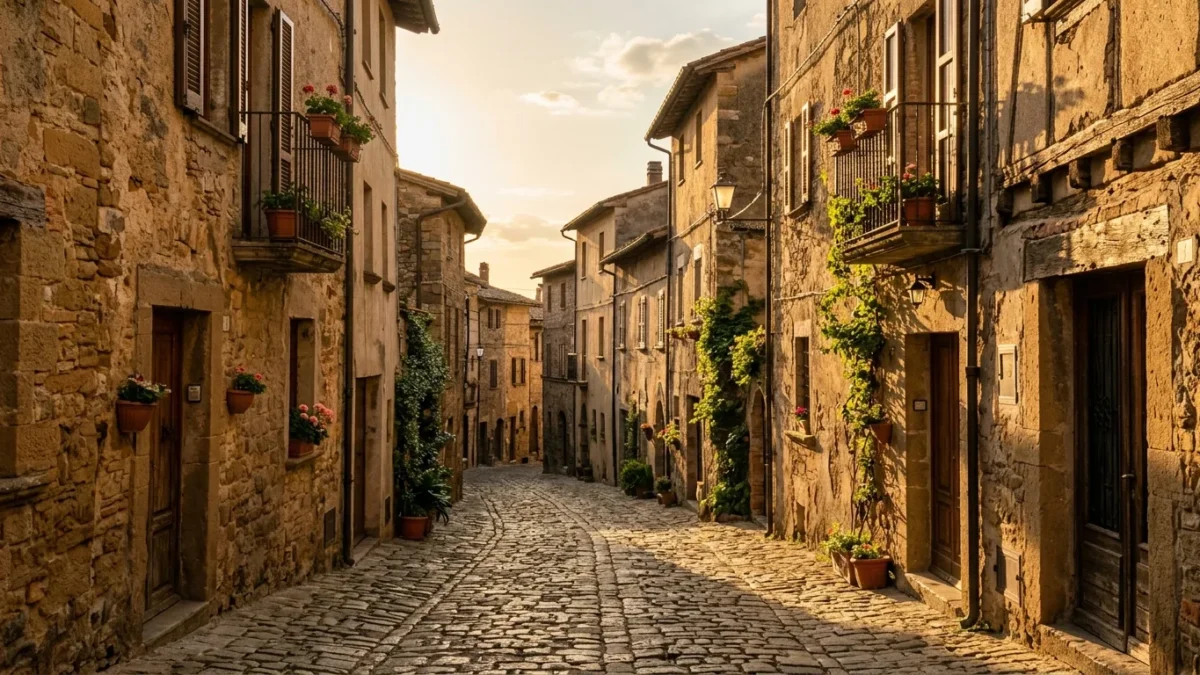
Golden Hour in the Old City: A Slow Walking Guide
How to spend the last hour of daylight wandering an old European city on foot, trading the checklist for the small, unhurried pleasures of light and side streets.
The cobblestones hold the day’s warmth a little longer than the air does, and you feel it through your shoes about an hour before the sun goes down. This is the moment to put the map away. Most travelers spend golden hour rushing toward a famous viewpoint, jostling for the same photograph everyone already has. The quieter pleasure is to walk slowly through an old city while the light does its work on ordinary things: a chipped green shutter, a bicycle leaning against limestone, the gold edge along a row of rooftops.
Slow travel is less a method than a permission. You are allowed to be late. You are allowed to choose a street simply because it curves and you cannot see where it goes. The old quarters of European cities were built for people on foot, long before timetables, and they reward anyone willing to move at their original pace.
Begin Where the Crowd Thins
Start at the edge of whatever counts as the busy part, then turn away from it. If a square is full, take the smallest street leading off it. The rule is simple and almost always works: follow the lane that looks too narrow to matter. Within two turns the noise drops, the souvenir shops vanish, and you find the city people actually live in.
Here the light arrives differently. It comes in slices between tall buildings, catching laundry lines and the steam from someone’s kitchen window. You will pass a cat asleep on a doorstep, a man watering geraniums, a bakery pulling down its shutter for the night. None of this is on any itinerary, which is exactly why it is worth your hour.
Walk with your hands free and your phone in your pocket. Let yourself stop without a reason. The whole point of golden hour on foot is that there is nowhere you have to be by the time it ends.
Klik hieronder op de knop Verder lezen om door te lezen.
Reacties (4)